Best Platforms for Online Tutors: 2026 Tutor Guide
The number of tutors working online has never been higher, and neither has the competition for students. Choosing from the best platforms for online tutors is not just a question of where to list your profile. The platform you choose can shape your calendar, your margins, your admin load, and the evidence parents see before they book.
A tutor with a half-empty timetable rarely has only one problem. They may need inbound enquiries, clearer proof of expertise, better follow-up after lessons, or a way to show progress without manually building reports every week. That is why the smartest tutors often use more than one tool: a marketplace for reach, a profile page for trust, and a specialist workflow for teaching quality.
The platform that fills your calendar is useful. The platform that proves why students should stay is strategic.
Best platforms for online tutors at a glance
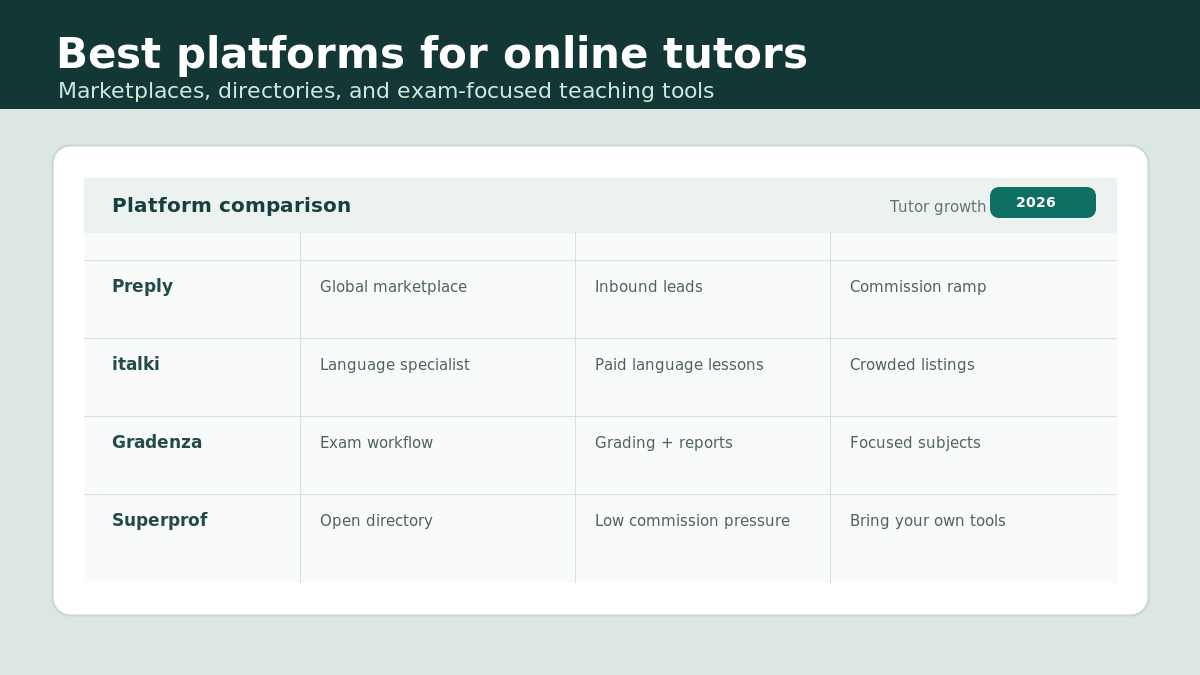
Each platform below solves a different version of the same problem: how a tutor gets found, trusted, booked, and retained. The right choice depends on your subject, geography, tolerance for commission, and how much teaching infrastructure you want the platform to provide.
| Platform | Best fit | Main advantage | Main trade-off |
|---|---|---|---|
| Preply | Language and general academic tutors seeking global demand | Large student marketplace with scheduling, payments, and classroom tools | Commission is highest early, and trial lessons are unpaid for tutors |
| italki | Language tutors who want a specialist language marketplace | Clear language-learning positioning and paid lesson model | Discoverability depends heavily on profile quality and reviews |
| Gradenza | Exam-focused tutors and schools working with structured marking | Auto-grading, analytics, public profiles, testimonials, and report evidence | Not a general marketplace for every subject |
| Superprof | Tutors who want directory-style reach across many subjects | No lesson commission for tutors | Less built-in teaching infrastructure |
| Wyzant | US-based academic tutors | Established marketplace with payment and classroom infrastructure | US-residency constraint and platform fee on marketplace lessons |
1. Preply
Preply is one of the largest tutoring marketplaces in the world, connecting students with tutors across more than 90 languages and a growing range of academic subjects. It is best known for language learning, but its scope has expanded considerably.
For tutors, the draw is access to a global student pool. Preply handles scheduling, payments, and a built-in virtual classroom with an interactive whiteboard, file sharing, screen sharing, and AI-powered lesson summaries after sessions. For a tutor who wants inbound demand without building a marketing funnel from scratch, that infrastructure matters.
The trade-off is commission. Preply's current tutor help materials describe a commission model that starts at 33% for new tutors and can drop as teaching hours accumulate, with trial lesson commission set at 100% of the trial value. That can be a meaningful cost in the first months, especially while you are still gathering reviews and repeat bookings.
Preply also invests in tutor development through webinars, tutor support, and product features that reduce lesson admin. If you are willing to absorb the early commission while building a review base, Preply can generate consistent inbound leads without much self-promotion on your part.
Best for: Tutors focused on languages or broad academic subjects who want a large, ready-made audience and do not mind a commission-heavy ramp while building their profile.
2. italki
italki has been around since 2007 and occupies a similar marketplace position to Preply, with a tighter focus on language learning. It is usually evaluated by tutors who want access to language students rather than a general academic tutoring audience.
There are two broad categories of tutor on italki: Community Tutors, who offer conversational practice, and Professional Teachers, who are expected to demonstrate qualifications and experience. This tiered structure lets the platform serve a wide range of learners without forcing every tutor through the same credentialing path.
italki's appeal is its specialization. A profile is framed around language goals, conversation fluency, lesson style, and teacher background. Tutors can charge for sessions rather than relying on unpaid trials as the default entry point, and international withdrawal options make the platform practical for tutors outside the US.
The weakness is discoverability. With a large and competitive tutor pool, standing out requires sustained work on your profile, intro video, lesson packages, and review count. Growth can be slow before reviews accumulate, especially in languages with many experienced teachers already listed.
Best for: Language tutors who want a specialist marketplace and are comfortable building reputation gradually through reviews, repeat students, and a strong introductory video.
3. Gradenza
Gradenza is a different kind of platform. Rather than a general marketplace, it is built for tutors, teachers, and schools preparing students for structured examinations. That includes IB Mathematics AA and AI in the current grading workflow, with Physics and Biology planned as Phase 2 subjects, and broader support across exam systems such as WAEC and EGE/OGE in the product.
Grading that saves hours per week
If you teach exam classes, marking is not just admin. It is where you see whether a student knows the method, whether they carried an earlier error coherently, and whether feedback should target a concept or a careless execution slip. Gradenza auto-grades IB submissions using LLMs and human-verified markschemes, then gives teachers structured reports with amber-flagged uncertain items and one-tap overrides.
For IB Mathematics, Gradenza is designed around the distinction between method marks and accuracy marks, with Follow Through logic implemented statefully across dependent question parts. That means a later answer can be evaluated against the student's own earlier value when the markscheme allows it, rather than treating each part as an isolated final answer check. Students can submit work by photo or Google Drive, which keeps the workflow close to how handwritten exam preparation already happens.
Proof assets for serious tutors
Gradenza is also useful because the teaching workflow creates evidence. A public tutor profile can show specialisms, exam systems, a direct contact path, and approved student video testimonials. For exam-focused tutors, structured reports and mastery data become more persuasive than a generic sentence saying "I help students improve".
This matters when a parent compares you with three other tutors. A real grading report, a mastery map, and a profile that names the exact exam system can make your process visible before the first call. Gradenza is free for up to 5 students, which makes it practical to test with an existing small group before moving a full tutoring workflow onto the platform.
Best for: Tutors working with IB, WAEC, EGE/OGE, or similar exam students who want to spend fewer hours on marking and more on teaching, while turning verified student progress into stronger proof for prospective families.
4. Superprof
Superprof is a large open directory of tutors, operating across many countries and a broad range of subjects, from academic tutoring to music, sport, and practical skills. For tutors with niche or non-traditional subjects, that breadth is a genuine advantage.
The business model for tutors is attractive on the surface: Superprof says it takes no commission from lessons, so tutors keep what they charge. The platform's model is closer to a directory than a managed teaching environment, with students paying for access to contact tutors in many markets.
The absence of commission is a real advantage for established tutors with their own teaching setup. The downside is that Superprof generally provides less classroom infrastructure than a managed tutoring platform. Tutors bring their own video conferencing, resources, progress tracking, payment habits, and follow-up systems.
Profile visibility can also be affected by optional upgrades and the competitiveness of the local subject market, so "no commission" does not always mean "no acquisition cost". It means the cost structure is different.
Best for: Experienced tutors who already have a teaching setup and want directory-style discoverability across a wide range of subjects without sacrificing a percentage of every lesson fee.
5. Wyzant
Wyzant is one of the oldest and largest tutoring marketplaces in the United States. It is primarily US-focused, and tutors need to meet the platform's eligibility requirements, but within that market it has meaningful reach across hundreds of subjects.
The platform's tutor help materials state that tutors retain 75% of their posted hourly rate for marketplace lessons, while Wyzant retains a 25% platform fee. That is simpler than a tiered commission model, but it is still a substantial margin consideration if most of your students come through the platform.
Wyzant's built-in Learning Studio includes video, an interactive whiteboard, a code editor, document sharing, and text editing, which makes it one of the more capable native teaching environments among major marketplaces. For academic tutors who want to avoid assembling a separate stack for video, files, and payments, that is useful.
The challenge is the same as most marketplaces: review count, response speed, subject relevance, and pricing all affect how often a tutor converts search exposure into actual students. Newer tutors may need time to build enough proof to compete in popular subjects.
Best for: US-based tutors across a broad range of academic subjects who want an established marketplace with solid payment infrastructure and a capable built-in classroom.
How to choose the right online tutoring platform
The most successful tutors rarely treat platforms as mutually exclusive. Instead, they assign each platform a job. A marketplace can help you get initial enquiries. A directory can help you be found for a niche subject. A public profile can give parents one clean place to evaluate your expertise. A grading and analytics platform can make student progress visible.
- Start with subject fit. Language tutors should compare language marketplaces first. Exam-focused tutors should prioritize platforms that understand marking, topics, and reporting.
- Calculate effective cost. Commission, unpaid trials, optional profile boosts, and external tools all affect your true platform cost.
- Look for proof, not just visibility. A profile view is only useful if the page helps a parent trust you enough to enquire.
- Choose tools that compound. Reports, testimonials, public profiles, and reusable resources become more valuable over time.
Conclusion: the best platforms for online tutors work as a stack
The best platforms for online tutors serve meaningfully different needs. Preply and Wyzant can help generate inbound leads. italki is a focused option for language tutors. Superprof offers directory-style reach without lesson commission. Gradenza is the specialist layer for tutors who need exam-aware grading, analytics, and proof assets that show how their teaching actually works.
If you teach structured exams, add Gradenza to that stack early. The hours saved on grading become more hours for teaching; the structured reports become evidence for parents; and the public profile, testimonials, and student progress data make your tutoring easier to trust.
To turn handwritten submissions, exam-specific grading, and student progress reports into a stronger online tutoring workflow, try Gradenza free.