Where to Find Teacher Resources: 5 Best Platforms

Preparing lessons, designing assessments, building question banks, writing mock exams — the workload behind every hour of teaching is substantial. And most of it is invisible to students and parents.
The good news is that there is no longer a good reason to start from zero. A growing set of platforms gives teachers access to teacher resources created by other educators — quizzes, worksheets, exams, question banks, lesson plans — that can be used as-is or adapted for a specific class. The difference between a good resource platform and a great one comes down to depth, searchability, and how much editing freedom you actually have once you download something.
Here are five places worth knowing about.
Teacher resources platform comparison
| Platform | Best for | Main limitation |
|---|---|---|
| Teachers Pay Teachers | US K-12 worksheets, lesson plans, activities, and classroom-tested materials | Less precise for international exam systems |
| Tes | UK, Commonwealth, GCSE, A-Level, and secondary subject resources | Quality varies; exam-specific filtering can require extra work |
| Gradenza Resources Hub | Exam-focused quizzes, notes, question banks, and forkable assessment materials | Most useful when your teaching is organised around structured exams |
| Quizlet | Vocabulary, definitions, factual recall, and independent student practice | Not ideal for long multi-step worked problems |
| TeachShare | AI-generated differentiated materials and standards-aligned K-12 content | Less calibrated for specialist exam markscheme logic |
1. Teachers Pay Teachers (TPT)
Teachers Pay Teachers is the largest peer-to-peer marketplace for educator-created resources in the world, with more than four million resources available covering every grade level and subject imaginable.
The model is simple: teachers create and upload materials — lesson plans, worksheets, assessments, activities, rubrics, unit plans — and other teachers can download them, often for a small fee. What sets TPT apart from traditional educational resource providers is its peer-to-peer approach, where educators themselves create and share materials they have developed and successfully used in their classrooms.
The practical appeal is obvious: someone who has already taught the exact topic you are preparing for has likely already built something useful, tested it on real students, and refined it. You are not downloading theoretical materials — you are borrowing from a practitioner's actual lesson bank.
The platform handles critical elements like customer service, payment processing, and sales tax remittance, so sellers can focus on creating rather than administering. For buyers, the search filters allow you to drill into subject, grade level, resource type, and standard alignment quickly.
The main limitation is that TPT skews heavily toward K-12, with its strongest coverage in US elementary and middle school curriculum. For tutors working in international exam systems — IB, Cambridge, WAEC — the coverage is thinner and requires more careful filtering. Still, for teachers in the US curriculum space, it remains the default first stop.
2. Tes
Tes is the UK's largest teaching resource platform, with more than 900,000 resources made by teachers for teachers across primary and secondary education.
The platform operates on a similar peer-sharing model to TPT, but with a distinctly British curriculum orientation — strong coverage of GCSE, A-Level, and key stage subjects — and a significant international following among teachers in Commonwealth countries and international schools. Many resources are free; others are paid.
What teachers consistently highlight about Tes is that it can give you keyword matches or key stage matches, and if a resource has high ratings it is likely that you might find it useful as well. The rating system and the ability to save resources to a favourites list make it practical to evaluate materials quickly before committing to a download or purchase.
The best resource platform is not the one with the most files. It is the one that helps you find a usable, editable resource before preparation time disappears.
Tes brings people together in a sense of a teachers' community — there are forums where you can ask for advice if there is something you are not sure about. Beyond the resources themselves, this community layer is where a lot of the real value lives: experienced teachers answering specific questions about curriculum, exam technique, and lesson design.
For IB and international curriculum teachers, Tes is worth checking specifically for secondary maths and science, where the overlap between UK A-Level and IB content is substantial. Do not expect the same level of exam-specific alignment you would find on a specialist platform, but the quality of the best-rated resources is genuinely high.
3. Gradenza Resources Hub
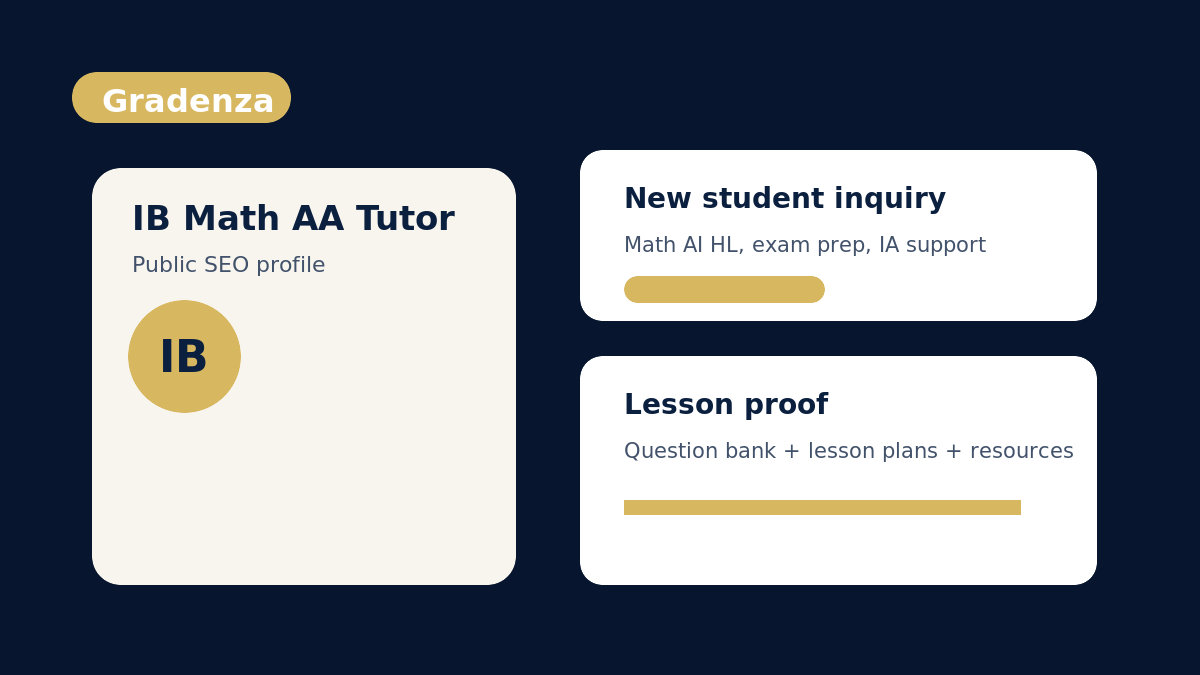
Gradenza is primarily known as an AI grading and homework platform for exam-focused tutors — covering IB Mathematics AA and AI in Phase 1, with Physics and Biology planned for Phase 2. But embedded within it is a Resources Hub that works quite differently from the large general marketplaces above, and that difference matters for any tutor whose students are working toward a specific qualifying exam.
A community feed built around real exam systems
The Resources Hub is a shared library where teachers and tutors post quizzes, question sets, exam papers, and notes that are tagged to specific exams and subjects — IB, SAT, AP, WAEC, EGE/OGE, and more. Unlike a general marketplace where you search broadly and filter down, Gradenza's feed is exam-native from the start: everything is already organised around the frameworks your students are being assessed on.
Upvoting and discoverability that actually works
Resources can be upvoted and downvoted by the community, so the best materials surface naturally over time. Filters for subject, exam type, topic, and difficulty level make it practical to find what you need in a couple of clicks rather than browsing through pages of loosely related content.
Fork, modify, and make it yours
Any public resource in the feed can be forked — saved to your own library and edited to fit your specific class. Changed the difficulty, removed a question, added your own instructions? That is your version now, and you can save it privately or share it back with the community. It is the git model applied to teaching materials, and it removes the all-or-nothing limitation that affects many resource platforms.
Generate resources from scratch, with your own criteria
If you cannot find exactly what you need in the feed, Gradenza lets you generate quizzes and question banks directly — specifying the rubric, difficulty definition, topic coverage, and question format, including multiple choice or free response. For IB tutors who need questions that align precisely with markscheme logic and mark allocation structure, this is the difference between a resource that works and one that needs heavy editing before it is classroom-ready.
Contribute and earn
Teachers who make their materials public earn credits on the platform, redeemable as AI credits for grading API calls — a small but meaningful incentive to share good work rather than keep it private.
For tutors working in the IB, SAT, AP, or other structured exam systems, the Resources Hub fills a gap that TPT and Tes largely leave open: exam-specific, community-validated, and editable materials, with a generation tool for cases when you want to build from scratch.
4. Quizlet
Quizlet occupies a different position from the other platforms on this list: it is less a resource library and more a study tool infrastructure, with an enormous community-built content layer on top.
It features more than 900 million study sets, each one being like a deck of flashcards. Teachers can search for existing study sets on virtually any topic, clone and edit them, or build their own from scratch. Students access the same sets and can study through multiple modes: flashcards, Learn, Test, and Match.
Recent updates have added an upgraded Learn feature enhanced by AI/ML, which adjusts question difficulty, improves grading accuracy, and adds motivational cues, alongside Study Groups for peer learning and AI-powered set generation from notes or uploaded documents.
For teachers, the most practically useful feature is Class Progress, which gives a detailed view of which students have started or completed their study sessions, and class-level data on their most to least missed terms. That helps you pinpoint exactly which concepts need more review and turns Quizlet from a passive resource into a lightweight formative assessment tool.
The limitation is format. Quizlet is excellent for vocabulary, definitions, key concepts, and factual recall — it is less suited to the kind of multi-step worked problems that dominate maths and science exam preparation. For language-based subjects, history, biology, chemistry concepts, and economics definitions, it is one of the most efficient tools available. For IB Mathematics problem sets or EGE algebra, you will need to look elsewhere.
5. TeachShare
TeachShare represents a newer generation of teacher resource tools, built around AI-powered generation rather than peer-to-peer sharing. It is a platform for educators to create and differentiate instructional materials and curriculum with AI, with a large educator user base.
The core workflow is different from downloading something someone else made: you describe what you need — topic, grade level, standard, question format, difficulty, language — and TeachShare generates a resource to your specification. Teachers can drop in static PDFs, scanned handouts, or curriculum materials and turn them into editable, interactive resources.
The toolbox is extensive: lesson plan generators, rubric generators, multiple choice quiz creators, informational text generation, vocabulary list generators, math word problem writers, and text-dependent question sets, among others. The platform also handles differentiation in a way that manual resource creation rarely does — generating the same content at multiple reading levels or with ELL scaffolding built in, without requiring the teacher to rebuild the resource from scratch.
AI rubrics that read student responses and score by concept mastery, not keyword matching, with real-time class trends and individual progress are available on the platform, pointing toward a future where resource creation and formative assessment are increasingly integrated.
TeachShare is strongest for teachers working in standard K-12 curriculum contexts, particularly in North America, where aligning to common standards and grade-level frameworks is the primary design constraint. For exam-specific preparation — IB, AP, Cambridge — the generation tends to be less precisely calibrated than what a specialist platform can offer, but for general subject content and differentiated materials, the time savings are substantial.
Which teacher resources platform should you use?
These platforms are not mutually exclusive, and the best answer depends on what you teach.
If you work with US K-12 curriculum, TPT and TeachShare are your most productive starting points — TPT for peer-validated materials that have been classroom-tested, TeachShare for rapid custom generation when you need something specific.
If you are in a UK or Commonwealth school system, Tes is the most relevant peer-sharing platform, with strong secondary coverage and an active teacher community.
If your students are preparing for structured qualifying exams — IB, SAT, AP, WAEC, EGE — Gradenza's Resources Hub is the most directly applicable, with exam-native filtering, forkable community materials, and a generation tool built around the specific rubrics and question formats those exams use.
And if you teach anything where knowledge recall and vocabulary are central, Quizlet's study set library is one of the fastest ways to get students practising independently.
The honest answer for most exam-focused tutors is a combination: Tes or TPT for lesson-level materials, Gradenza for assessment and exam-specific question banks, and Quizlet for student self-study between sessions.
Gradenza is free for up to 5 students. Find exam-focused teacher resources in Gradenza.