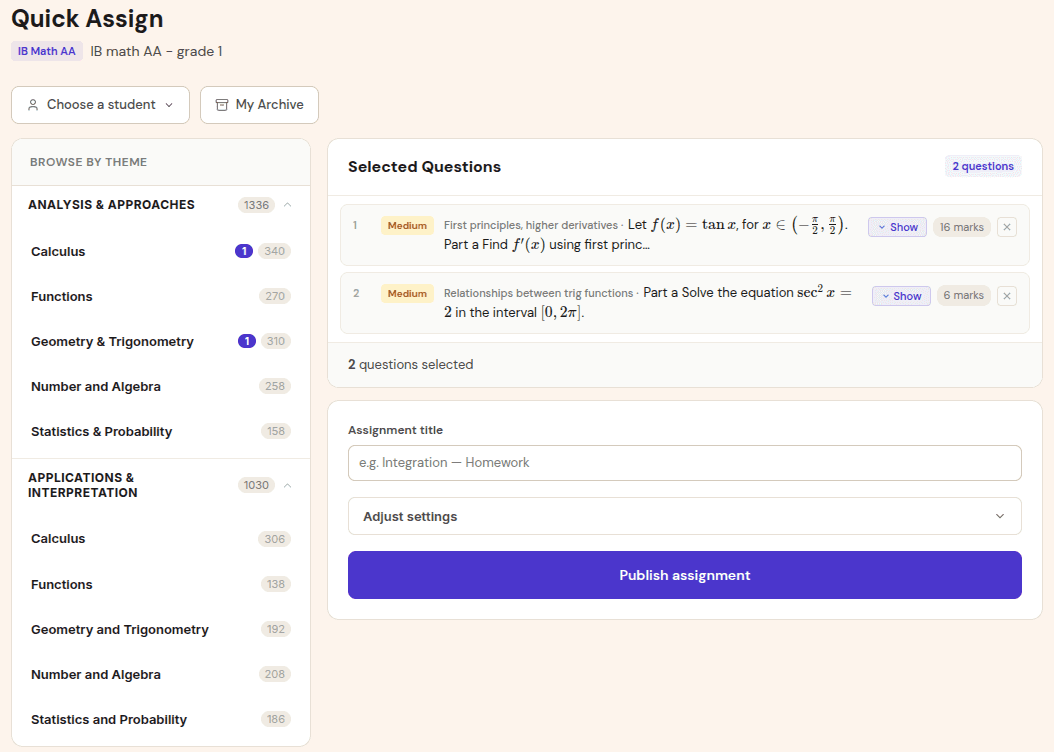
Attach the question context
Assignments carry exam, course, topic, marks, and dependency information where available.
Markscheme-based grading
Gradenza grades math work against the markscheme instead of treating AI as a final-answer checker. It reads handwritten submissions, applies method and accuracy decisions, labels review points, and keeps teachers in control before feedback or mastery updates are released.
Audience
Use this workflow when the marking guide matters as much as the student answer.
IB Math teachers who need method, accuracy, reasoning, and Follow Through marks.
Tutors who want feedback reports grounded in the markscheme.
Schools standardising grading across assignments and mock exams.
Teachers wary of black-box AI scoring and looking for reviewable decisions.
Workflow
The markscheme, question structure, and student working stay connected through the grading report.
Assignments carry exam, course, topic, marks, and dependency information where available.
Students submit handwritten photos, PDFs, stylus exports, or Drive files for grading.
The report separates method, accuracy, reasoning, and dependent marks instead of collapsing everything into a score.
Teachers inspect the report, adjust decisions, then release feedback or write grades back when ready.
Use cases
Markscheme-based grading is most useful when students can earn credit through process.
Award method credit for a correct setup even if the final calculation contains an arithmetic error.
Evaluate a later part against the student own figure when the markscheme allows it.
Use labelled decisions and amber flags so teachers can focus moderation on uncertain cases.
Benefits
Math teachers need grading that explains why a mark was awarded or withheld.
Students see which part of the markscheme their working satisfied or missed.
The grading report can recognise correct reasoning even when the final answer is not correct.
Because each result is tied to question and topic context, finalised marks can feed mastery maps.
Proof and trust
The system is designed to support teacher judgment rather than hide it.
Reports show the grading rationale at question or part level.
Teachers can adjust marks before feedback reaches students.
Question context can include topic, subtopic, marks, course, and dependency data.
Related resources
Continue into the adjacent workflow instead of treating this page as a dead end.
FAQ
It means the AI evaluates student work against the marking guide, including partial credit and method decisions, instead of only comparing final answers.
Yes. When the question dependency is known, Gradenza can evaluate later work against the student carried value.
Yes. The report is designed for teacher review and adjustment before feedback is released.
Next step
Try Gradenza with one markscheme-based math assignment and review the grading decisions before release.